




Permanent magnets PM1055
PM1055: a reference magnet in the palm of your hand

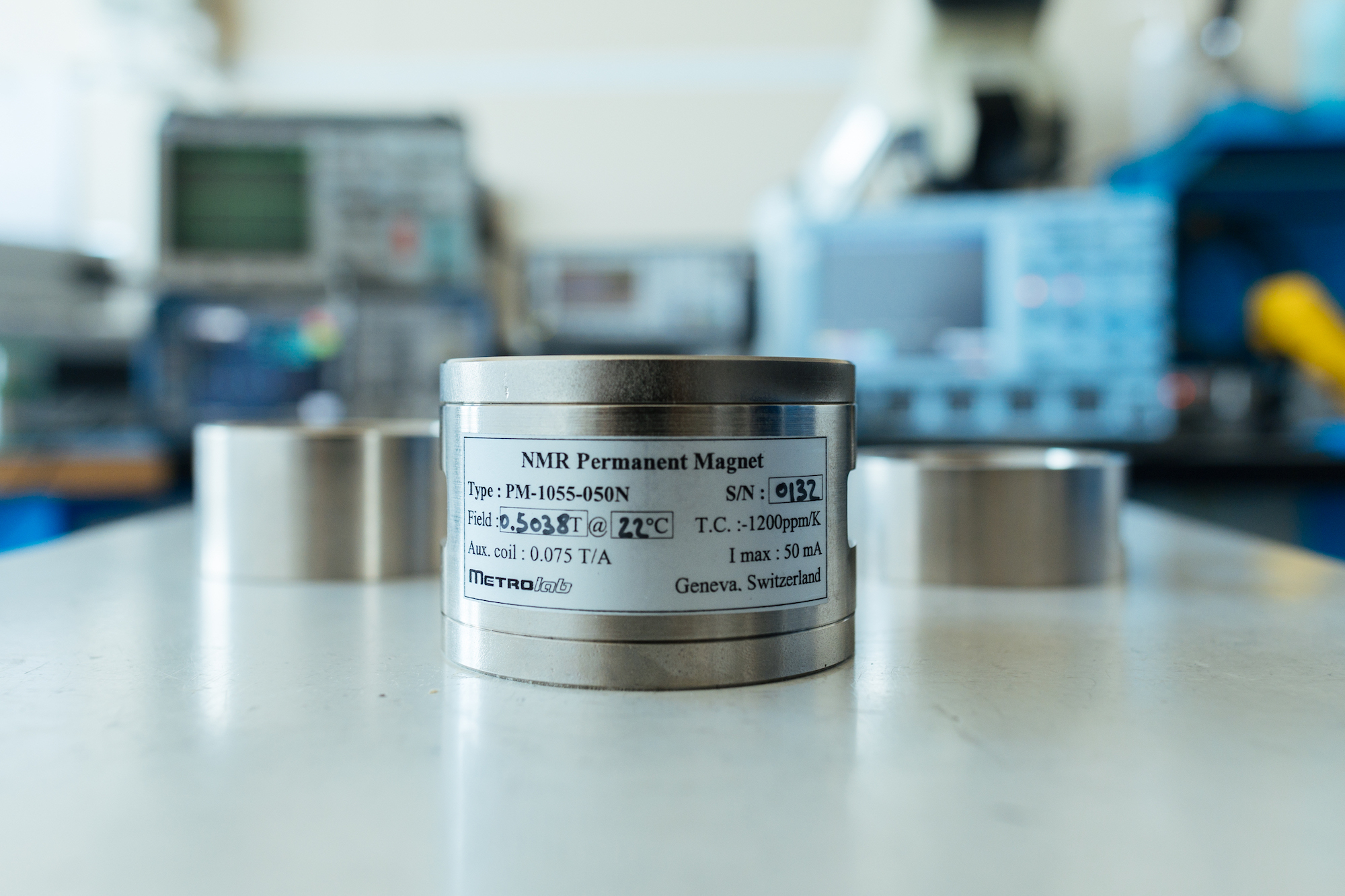
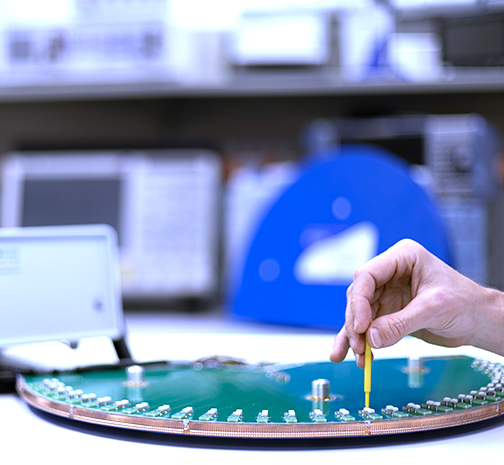
Metrolab's permanent dipole magnets are serious scientific instruments, in a deceptively small and elegant package. Available in fields from 0.01 to 0.5 T, they are remarkably compact, weighing just around a kg and measuring 80 mm in diameter and 39 mm (0.01 - 0.27 T) or 55 mm (0.5 T) high.
The magnetic field: more than meets the eye
Depending on the strength required, we use Ferrite, Samarium-Cobalt, or Neodymium-Iron-Boron as core material. The pole face diameter is 50 mm, and the gap is 13 mm. The unique pole shape and gap adjustment allow us to create a 12 mm uniform region, capable of accepting NMR probes. In spite of such tight requirements in an incredibly compact package, our design allows for two large openings (32 mm x 14 mm) for accessing the gap, as well as a small fringe field.
NMR stabilisation
All permanent magnets are sensitive to
temperature. The strength of the core material itself decreases with
increasing temperature, and thermal expansion changes the pole gap and
therefore the field. PM1055 magnets include an auxiliary coil to offset
all drift and to provide a perfectly stable field. If you stabilize the
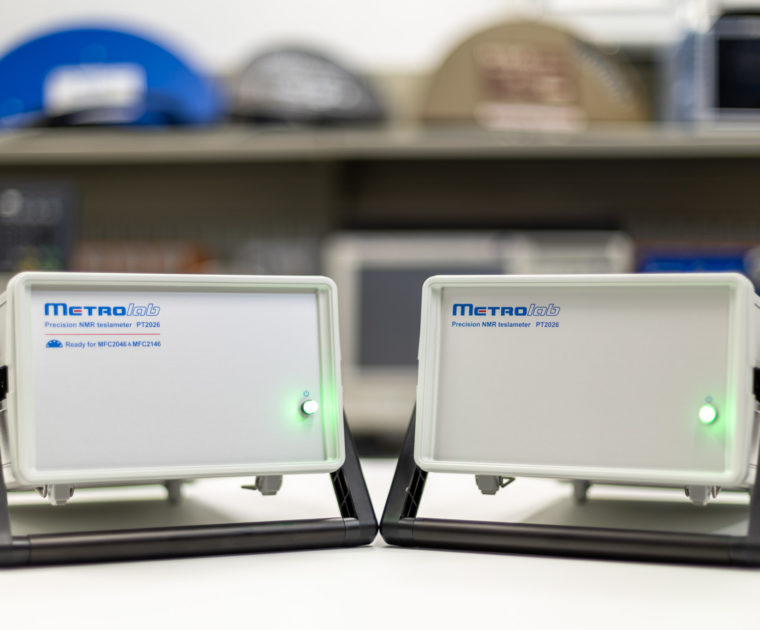
magnetic field with an NMR teslameter, the PM1055 becomes an
ultra-compact reference magnet, stable to within a few parts per
million.
Complete characterisation
After assembly, each PM1055 magnet is
serialized and individually characterised with an NMR Precision
Teslameter. The exact field strength in the middle of the pole as well
as a few representative points near the periphery, the temperature at
which the field strength was measured, the temperature coefficient, the
characteristics of the auxiliary coil – everything is marked right on
the label.
Fringe benefits
All magnets generate a fringe field, or field
outside the primary gap. You need to know the characteristics of the
fringe field not only to avoid sucking up nuts and bolts (potentially
dangerous for yourself as well as the magnet), but also to avoid
placing ferrous material where it affects the value of the field in the
gap. Those lucky enough to own a
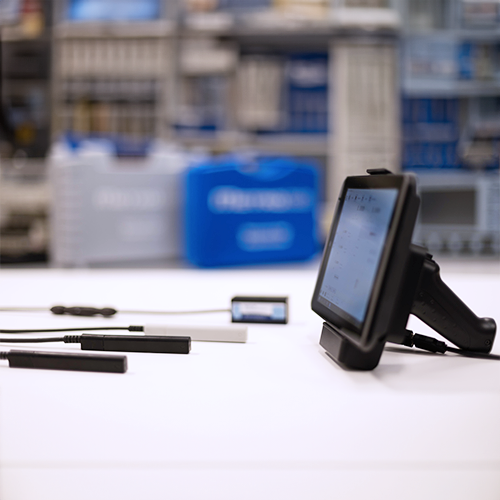
Three-axis Handheld Magnetometer can
of course easily map the fringe field; others will be happy to receive
Metrolab's fringe field characterization.
Download data sheets and price list